First recorded worship
1844
A small house at Kotahena was set aside for worship for the Polwatte community.
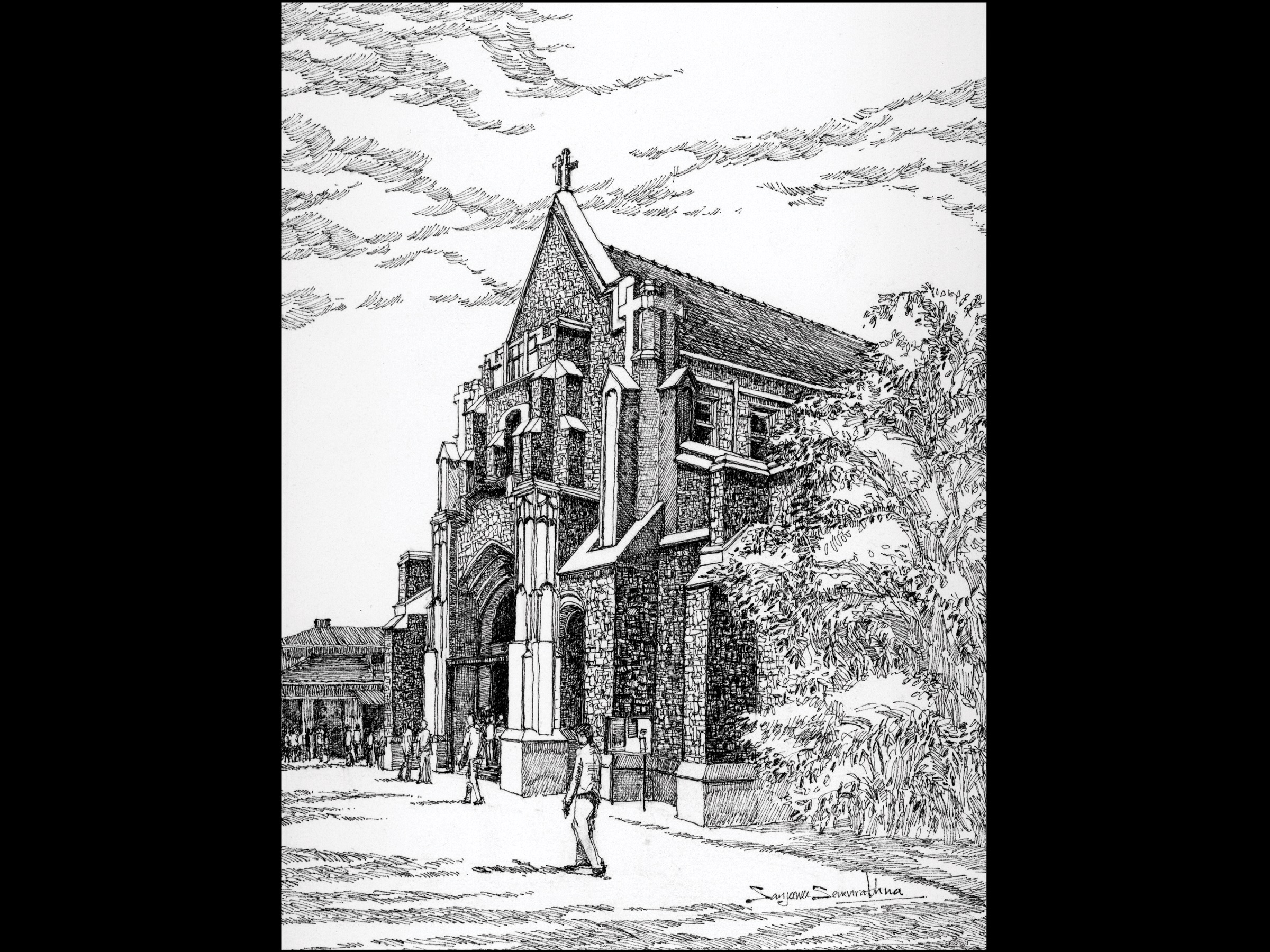
From a small worshipping community in Polwatte to a parish of three congregations, discover the story of St. Michael and All Angels.
Our timeline
The story of St. Michael and All Angels begins in the growing neighbourhood of Polwatte, where a Christian community took root in the nineteenth century and gradually built a life of worship in Sinhala, English, and Tamil.
Over the years, the parish has known change, rebuilding, dedication, music, outreach, and renewal. What began as a small chapel dedicated to St. Thomas grew into the church we know today: a landmark of worship in Polwatte and a home to generations of Michaelites.
This first timeline draws on parish history now being gathered and scanned, and will continue to grow as more of St. Michael’s story is added.
First recorded worship
A small house at Kotahena was set aside for worship for the Polwatte community.
St. Michael’s dedication
The church was dedicated as St. Michael and All Angels on St. Michael’s Day.
Present church consecrated
The present church building was consecrated, marking a major new chapter in parish life.
Community outreach
Helping Hands began taking shape, growing into one of the parish’s most practical and compassionate ministries.
Explore the timeline
Early foundations
1844
A small house in Kotahena was set aside for Christian worship, and Solomon David is remembered among those who led the early services.
1853
Bishop Chapman, the first Bishop of Colombo, dedicated the first Polwatte church to St. Thomas. It was a simple building with half walls and a cadjan roof.
1867
After the earlier building was lost, a more substantial chapel was built on what became the present site of St. Michael and All Angels, and was dedicated by Bishop Claughton on 21 May 1867.
Becoming St. Michael’s
1887
As the congregation expanded, the church was renamed St. Michael and All Angels to distinguish it from the older St. Thomas’s church in Mutwal.
29 Sep 1887
The church was dedicated as St. Michael and All Angels on St. Michael’s Day, giving the parish the name it still bears with pride.
1887
The daily celebration of the Eucharist began, establishing a rhythm of worship that shaped the spiritual life of the parish.
1887
The Rev. P. B. Moonemale was appointed the first resident priest, remembered as the first Kandyan to be ordained.
Worship, music, and parish identity
1914
Under the Rev. C. M. Ricketts, the choir flourished and became known as one of the finest in Ceylon, while the pipe organ continued to enrich worship.
Mid 20th century
St. Michael’s deepened its identity as a parish rooted in the life of ordinary people, and one former vicar described it as the church of “the poor and the children.”
1965
Following a change in the weekly holiday, service times were revised, reflecting the life of the Sinhala, English, and Tamil congregations.
1987
The centenary of St. Michael’s was marked with thanksgiving services, a combined Eucharist, fellowship meals, and children’s events across the life of the parish.
Renewal and shared life
1993
An Extraordinary General Meeting established a team-based model for the life and work of the parish, strengthening shared responsibility between clergy and laity.
1994
A joint Parish Pastoral Council for the English, Sinhala, and Tamil congregations was formed, reflecting the church’s shared life across languages and traditions.
1995
Healing services, expanding lay ministry, and the path toward a trilingual choir all became part of a wider renewal in parish worship and fellowship.
26 Sep 1996
The present church building was consecrated by Bishop Kenneth Fernando, marking one of the most significant milestones in the modern history of St. Michael’s.
1997 onwards
Breakfast after Sunday worship, monthly evensong, family camps, ecumenical friendships, communion visiting, and stronger lay ministry all helped shape the St. Michael’s many know today.
Buildings, memory, and service
After Archdeacon Matthew
Soon after the death of Archdeacon Matthew, friends who had valued his ministry supported the building of a parish room at St. Michael’s. In time, this memory of his service became bound up with what the parish came to know as Matthew Hall.
Later development
The hall complex was later rebuilt and strengthened through the pooled expertise, generosity, and hard work of parishioners, consultants, architects, engineers, and the construction committee. It became a practical centre for the life of the parish.
April 1967
Under the Rev. Swithin Fernando, a small group began studying the needs of the neighbourhood around the church. One pressing concern was malnutrition, especially among children and mothers in Polwatte.
Late 1960s-1970s
What began as a nourishing soup programme for sick and undernourished children, pregnant mothers, and older people grew into a broader feeding ministry. The work developed through close partnership with the Sisters of St. Margaret and other parish volunteers.
Social outreach
The same spirit of service also led to girls’ training courses, children’s programmes, family support, and eventually the beginnings of a free medical clinic. These ministries helped make St. Michael’s a place of mercy as well as worship.
This timeline is the beginning of a larger parish history project. As more of the church’s archives are scanned and gathered, further dates, clergy, ministries, and milestones will be added.
Explore more
who we are
latest notices
seasonal worship
